Best Virtual Assistant for Insurance Agencies in 2026: What to Look For
Choosing a virtual assistant for an insurance agency is not as simple as comparing hourly rates.
The VA market gives agencies more options than ever, but those options are not necessarily comparable. One provider may offer general administrative support. Another may specialize in insurance workflows. Some may provide a dedicated assistant, while others focus on task-based outsourcing. Security, training, technology, management, and ongoing support can also vary significantly.
So how do you determine which provider is actually the best fit for your agency?
Start by looking beyond the sales pitch.
The right virtual assistant provider should understand insurance operations, respect licensing boundaries, protect sensitive information, and fit into the way your agency already works.
Here's a practical framework for evaluating your options.
What Does "Insurance-Trained" Actually Mean?
Many VA providers use phrases such as "insurance-trained" or "insurance experience."
But those terms can mean very different things.
At a basic level, insurance training may mean understanding common terminology: declarations pages, policy forms, certificates of insurance, endorsements, carriers, and basic policy workflows.
A stronger level of training includes familiarity with agency management systems and insurance technology. A VA may need to work inside systems such as Applied Epic, AMS360, EZLynx, or other platforms used to manage client and policy information.
At the strongest level, the VA understands how insurance agencies actually operate.
That means knowing the workflows behind:
New business processing
Renewal preparation
Certificate requests
Document follow-up
Client service
Claims follow-up
Carrier communication
Agency management system updates
The distinction matters.
A general administrative VA may be capable of entering information into a spreadsheet. An insurance-trained VA should understand why the information matters, where it belongs, and when a question needs to be escalated to a licensed professional.

What to Ask a VA Provider
Before choosing a provider, ask:
What insurance training does the VA complete before placement?
How do you test or verify that training?
What insurance systems and workflows does the VA already understand?
What happens when the VA encounters a question outside their role?
Those answers can tell you much more than the phrase "insurance-trained" on a website.
Look at the Security Environment, Not Just the VA
For an insurance agency, security should be part of the vendor evaluation from the beginning.
Your support team may interact with client records, policy information, agency management systems, carrier portals, and other sensitive data.
That means you should understand not only who is accessing the information, but also how that access is controlled.
Ask potential providers:
Are VAs working from personal devices or controlled environments?
What security controls are in place?
How is user access managed?
How is access removed when responsibilities change?
Are security processes independently audited?
How are security incidents handled?
A provider should be able to explain its security practices clearly rather than relying on a generic statement that the platform is "secure."
SecureEVAs, for example, positions security as part of the operating model, with SOC 2 Type 2 controls, device policies, and ongoing compliance audits.
For an insurance agency, that level of transparency is worth asking about regardless of which provider you choose.
Dedicated VA vs. General Outsourcing
Another important question is how the provider structures its support.
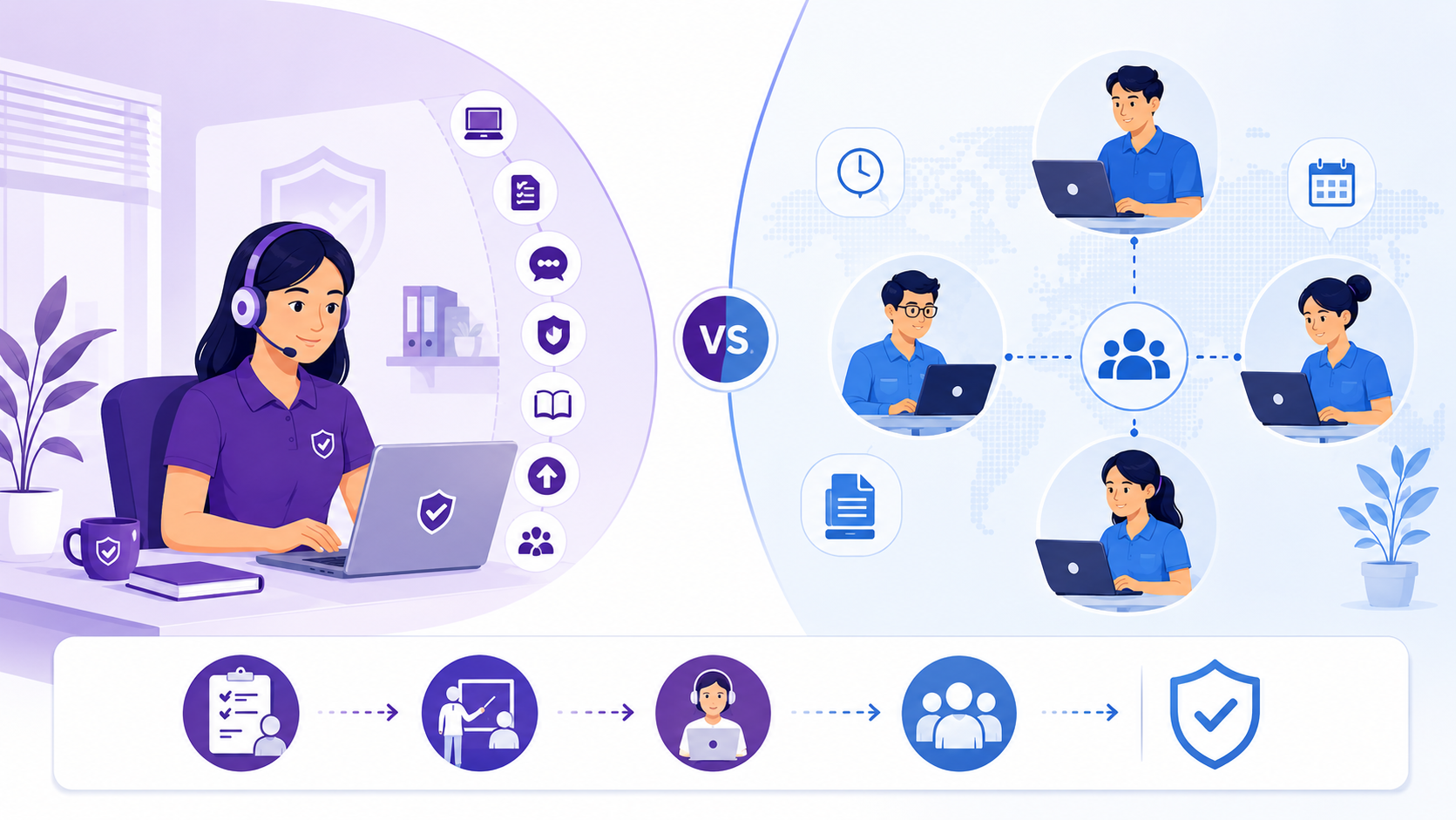
Will you receive a dedicated VA who becomes familiar with your agency, or will work move between multiple team members depending on availability?
Neither model is automatically right for every business.
But insurance agencies often benefit from consistency.
Your assistant may need to learn:
Your AMS workflows
Your internal SOPs
Your communication standards
Your carrier processes
Your preferred terminology
Your escalation rules
Your client service expectations
That knowledge becomes more valuable over time.
A provider should be able to explain exactly how it handles onboarding, training, supervision, and continuity when an assistant is unavailable.
Technology Familiarity Matters
A VA does not need to be an expert in every platform your agency uses.
But familiarity with insurance technology can shorten the learning curve significantly.
For example, an agency using Applied Epic, AMS360, or EZLynx may want a VA who already understands how those systems are used for common administrative workflows.
The goal isn't simply finding someone who can log in.
It's finding someone who can work within your existing processes without creating unnecessary friction.
That becomes especially important when an agency starts delegating more than basic data entry.
Human VAs and AI Tools Serve Different Purposes
AI is changing how businesses approach administrative work, and insurance agencies are no exception.
Automation can be useful for repetitive, structured tasks. It can help draft communications, summarize information, organize data, and support standardized workflows.
But agencies should not automatically treat AI and human VA support as interchangeable.
A human assistant can recognize context, ask a clarifying question, notice an exception, follow an established escalation process, and communicate with clients within defined boundaries.
AI can complement those workflows, but the right mix depends on the task.
The better question isn't:
"Should we use a VA or AI?"
It's:
"Which parts of our workflow should be automated, and which require human judgment, accountability, or relationship management?"
The strongest operating model may use both.

Don't Choose a Provider Based on Price Alone
Hourly cost is easy to compare.
Total value is harder.
A lower-priced VA may look attractive until you account for training time, management, quality control, security requirements, turnover, and the amount of work your internal team must spend teaching and supervising.
The same is true in the other direction. A higher price does not automatically mean better service.
Instead, ask what the price actually includes.
Does the provider handle recruiting and screening?
Is the VA trained before placement?
Is there ongoing management or quality assurance?
What technology and security controls are included?
How does the provider handle replacement or continuity?
What happens when your workload changes?
Those questions give you a much better basis for comparison than hourly rate alone.
For additional context, see our breakdown of what DIY administrative work really costs an insurance agency. The broader lesson is that the cost of an administrative task is not limited to the person's hourly rate; it also includes the time and capacity consumed by the process.
Look at What the VA Will Actually Own
Before choosing a provider, define the work.
A vague request for "admin support" makes it difficult to evaluate whether a provider is actually a good fit.
Instead, identify the workflows you want to delegate.
For example:
Renewals: tracking deadlines, gathering documents, following up on missing information, and preparing files.
Client service: acknowledging requests, collecting information, sending approved communications, and routing questions to the right person.
Document management: organizing files, following up on outstanding documents, and maintaining accurate records.
New business support: handling administrative follow-up after a policy is bound and keeping records updated.
SecureEVAs' content on keeping insurance renewals on track with a virtual assistant provides a useful example of how a defined workflow can be separated between administrative support and licensed staff.
The clearer the workflow, the easier it is to determine whether a VA provider is actually equipped to support it.
Client Service Should Be Part of the Evaluation
The best VA for an insurance agency is not necessarily the person who can complete the most tasks.
It may be the person who helps the agency create a more consistent client experience.
Response times, follow-up, onboarding, renewal reminders, and proactive communication all contribute to how clients experience an agency.
For example, SecureEVAs has written about how insurance agency response times affect client retention, including the role a VA can play in acknowledging requests and routing more complex questions to the appropriate licensed team member.
That distinction matters.
The purpose of a VA is not simply to make the agency busier faster.
It's to create capacity while maintaining the level of service clients expect.
Ask What Happens After You Hire
Choosing a VA provider is only the beginning.
You should also understand what happens after the placement.
A strong provider should have a process for:
Onboarding
SOP development
Performance monitoring
Communication
Quality control
Ongoing training
Escalation
Coverage during absences
This matters because insurance workflows evolve.
Your VA may begin with document follow-up and gradually take ownership of renewals, client communication, or other administrative processes.
The provider should be able to support that growth rather than leaving the agency to manage everything independently.
What Makes SecureEVAs Different?
SecureEVAs is built specifically around insurance agency operations.
The company describes its EVAs as pre-trained for insurance workflows, including policy servicing, claims intake and follow-up, renewals, COIs, and client support. SecureEVAs also states that its EVAs go through a structured screening and training process before placement.
That combination matters because agencies are not simply hiring an extra pair of hands.
They're bringing another person into workflows that can affect clients, policies, deadlines, and sensitive information.
The right provider should therefore bring more than availability.
It should bring training, structure, accountability, and a clear understanding of the environment it's supporting.
So, What Is the Best Virtual Assistant for an Insurance Agency?
There isn't one provider that is automatically the best choice for every agency.
The best fit depends on what your agency needs.
But the evaluation criteria should be consistent:
Insurance knowledge.
Security.
Technology familiarity.
Clear licensing boundaries.
Defined workflows.
Training and onboarding.
Ongoing support.
Client service standards.
Transparent expectations.
A provider that can answer those questions clearly is worth a closer look.
A provider that avoids them is not.
Start With the Work, Then Choose the Provider
Before comparing VA companies, identify where your agency is actually losing time.
Is it renewal preparation?
Document follow-up?
Client communication?
New business administration?
Claims follow-up?
Once you know the bottleneck, you can evaluate providers against a real business need instead of comparing generic promises.
And that's ultimately what makes a virtual assistant valuable.
Not simply having another person available.
Having the right person, with the right training, working within the right system, on the right work.